Thursday, 1 May 2014

Brum-Brum, We Rev Up For The Playoffs

Saturday April 19th. The season is rapidly drawing to a close and Forest's dreadful run shows no sign of ending. Two months without a win yet we are still in touch with the top 6 and have faint playoff hopes. How bizarre!

Before arriving at the CG I had another stop to make. Recent attempts to secure enough money to put in place a proper headstone to a former Forest favourite had succeeded and a small ceremony was held at Wilford Hill Cemetery to celebrate this achievement. I drive past the cemetery on my way to matches, so decided to leave home a bit early and search out the new memorial.

Tinsley Lindley was Forest's youngest ever player, turning out on 17 February 1882 when aged 16 and scoring a hat-trick in his first game. He once scored 85 goals in one season and here we are these days trying to find a 20 goal a season striker!
Tinsley was one of those sort of polymath sportsmen who seemed to exist in Victorian times as he excelled as a rower and, as well as being a fine footballer, played rugby and also first class cricket for Cambridge University and Notts CCC. At Cambridge he studied law and was called to the Bar in 1899 whilst still an active sportsman, though an amateur. He rose to high office in the law and in Nottinghamshire society, so it is a bit of a mystery why he was buried in an unmarked grave. On 31 March, club captain and vice captain Chris Cohen and Andy Reid amongst others, attended the unveiling of the memorial.

I had no idea where the memorial was in the grounds, but after studying photos of the players at the unveiling I ascertained the approximate location. I found it with no trouble. After taking a few photographs I found I had some time in hand and I went to look at a few headstones which intrigued me. They are set up in a quiet area in one corner near to the Commonwealth War Graves Commission graves to servicemen killed in, mainly, WWII. This area is, as always with the CWGC, is beautifully maintained and tastefully laid out. The graves in question are laid out in a row and all bear the same date, 9 May 1941. I discovered that there had been a large bombing raid on Nottingham (and Derby) on that date and the graves record some of the 159 victims of the raid.

Back to the football. The visitors were Birmingham City, themselves going through a poor run of form, though their away form remained quite sound. They had won their last two away games, but not recorded a win at St Andrews since 1 October to remain precariously close to falling into the relegation places. In their favour is the fact they have not lost at the CG since December 1999.

The game in Birmingham ended 0-0, but was not without it's moments. Midway through the second half the ball was put into the Blues net by Henri Lansbury, but in doing so he had to head it out of goalkeeper Randolph's hand as the 'keeper held the ball up to clear it. Goal disallowed. Then Darius Henderson was dismissed for a foul on Birmingham's captain, Robinson, but the reason for the dismissal was not immediately apparent to me. The tackle looked hard, but fair. The ref took his time to reach a decision and took the advice of his linesman before sending Henderson off. This was about 10 minutes before the end of the game, but Forest held on for the 0-0.

There were four changes made to the side that lost at QPR. Out went Wilson, Lansbury, Jara and Cox and in came Vaughan, Osborn, Collins and Paterson. Lansbury looked decidedly out of kilter at Loftus Road and I wouldn't be surprised if he failed to reappear again this season. The same goes for Wilson. Backs can be funny things (I know, I've had a back problem for over 50 years. The Doc said, when it first happened, "Ah, this is something that will either get better or get worse!" It hasn't got better) and I think the medical team have decided that the long term injury people can write this season off, strengthen and get fit during the summer ready for next season. Thus Cohen, Reid, Wilson, Lansbury, Hobbs and Lichaj will fill the physio's room instead of the CG until August.  Looking at that list, it's no surprise that our season has folded quite so badly, half of the first eleven out long-term. If you add the short-term injuries that crop up in every squad, we have had a devastating run of bad luck. I include in that a manager who went slightly more bonkers as the season progressed until he seemed to be having difficulty talking sensibly to himself, let alone others around him.

Birmingham seemed to realise that our sad winless run was undermining the confidence of our players and very kindly gave us a 1 goal lead. Actually, it was a fine through ball from Paterson that sent Derbyshire away through a square Blues defence and he coolly converted the one-on-one after less than two minutes play. After that, Forest played out the first half looking in command of the game, but failing to add to the score. After the season we have had, that fact alone made me nervous because we have almost never played two good halves consecutively this season and we have contrived to give away a one goal advantage far too often.

The second half was much more even. Forest started well, but faded as the half wore on and Birmingham had several very good chances towards full time, with Darlow making one outstanding save at the back post from Robinson following a corner. However, Forest saw out the game and came away with their first win since Huddersfield away on 11 February and the first win at the CG since Yeovil on Feb 2!! Young Ben Osborn was named MOTM, probably more for his determined and athletic display than his footballing excellence. Though he has come on in leaps and bounds since his debut at Ipswich showing a maturity way beyond his years.

It was a lovely evening and I drove home in good spirits, hopeful that all was not lost, we might still pull the rabbit out of the hat.

Thursday, 24 April 2014

Late drama at Loftus Road

Of course, anyone who has been to see Queens Park Rangers will know that the Loftus Road Stadium is not on Loftus Road, but South Africa Road.
The only contact the ground has with Loftus Road is between a couple of the house lining the said road, a narrow opening allowing patrons access to the turnstiles of the Loftus Road Stand.

Our game was televised and the road was lined with all sorts of vehicles connected with the TV company filming the event, from BT vans to giant artics to catering trucks setting out their stalls.

It is worth mentioning in passing that the gaps in the buildings giving access to the Ellerslie Road Stand turnstiles and those on Loftus Road were there long before the actual football ground existed, being evident on Ordnance Survey maps of the area in 1893, whereas the ground only came to be used as a football ground in 1904, by Shepherd's Bush FC. They soon disbanded and QPR took over the ground in 1917. Prior to moving to Loftus Road the club had had a nomadic existence having played at more than 10 grounds during their early years. And, even since moving into their present home, they have moved out a couple of times for short periods to the White City Stadium which used to be up South Africa Road towards Wood Lane. In fact the location of that iconic (well, to my generation anyway) stadium which was used for the 1908 Olympics, is where the away coaches are parked these days.

During my SAS days, we had a small depot near White City, which was the starting point for many interesting exercises throughout the UK and I was reminded of this when walking down South Africa Road and passing the 4 Para compound, as we were situated next door to 10 Para (as it used to be before reorganisation) in those far off days in the 60s and, as you can imagine, there was healthy rivalry between the two Regiments. I had a bit of time before the game started so I went for a moment of silent contemplation in Hammersmith Park, sandwiched between the BBC building and local housing, which is a haven of greenery and birdsong amidst the tarmac, brick and concrete of the surrounding cityscape. This park is all that remains of the garden area originally designed for the 1908 Olympics and redesigned as a Japanese garden for an exhibition in 1910.

Queens Park Rangers FC was formed in 1886 by the merger of two clubs, St Jude's  and Christchurch Rangers and presumably named as such because most of the players came from the Queen's Park area. It is interesting that the club claims to have been established in 1882, which is the date of the establishment of the oldest of the two clubs which merged to form QPR. Their nicknames are The Hoops, or Superhoops to ardent fans ( QPR being one of the few clubs in the league to play in hooped shirts), and The R's.

Loftus Road Stadium is a ground squeezed in amongst the houses of West London and it shows inside the ground. The stands cascade almost onto the pitch and it has an unfinished look, possibly because the club is looking at the possibility of moving to a bigger location. There are four stands and they are butt-jointed together so that part of each stand  has seating with restricted views at the extremities. The only place where the seating wraps around the corner is between the South Africa Road Stand and the Loftus Road Stand. At the other corners you can see evidence of preparations being made for the same effect, but it has just been abandoned for some reason.

The away fans are situated in the upper tier of the School End which is a similar layout to the Loftus Road Stand. The school giving it's name to this stand was in place long before the ground and the site is presently occupied by the Jack Tizard School. Fans may have noticed the exterior design of the school which is quite striking, a significant feature because the school presently caters for children with severe special needs. The club also uses the car park of the school as the player's car park on match days. Peering through the fence into the car park like a little boy peering into a sweet shop enabled me to have a few words with JJ (our own Jermaine Jenas) signed by QPR from Spurs. The regular QPR fans refer to the Loftus Road Stand as the Loft and it houses the police control box and on the facia between the two tiers is a small scoreboard.
This scoreboard is repeated at the School End, but a major difference here to the Loft is the location on the roof of a large video screen, which follows the practice seen at some other grounds of being totally invisible to the away fans.

The South Africa Road Stand is the oldest in the ground and is two tiers, the lower tier being very shallow indeed, with a mid-line of executive boxes. The seats are banded white and blue across the upper tier and the players tunnel and dug outs are on the halfway line. Opposite this stand is the Ellerslie Road Stand, a single tiered structure which has further evidence of the squeeze on space inside the ground. The media gantry is installed just under the roof of the stand and almost level with the touchline on that side of the pitch.
Also slotted in, right at the School End of the stand, is a glass fronted box, acting as a TV studio for the pundits at live matches, supported by a pillar and accessed by a set of stairs running up the back of the stand. Some of the restricted view seats are behind this monstrosity which, to my mind is taking the mickey, charging for such a poor view.

The game itself was I think, pretty exciting for the neutral, but ultimately heart-breaking for the Forest fans. Gary Brazil made four changes to the side which fought back so valiantly against Sheffield Wednesday. Collins was suspended after his red card so Kelvin Wilson came in for him and there were also starts for Fox, Cox and Halford. Tudgay, after such a fine first appearance of the season last week picked up an injury in that game (story of our season) and was out and Paterson was also absent through illness. David Vaughan was listed as a sub after another lengthy injury absence, this time for a broken kneecap, but he wasn't called upon to help the cause.

The game started disastrously for The Reds. Halford, whose praises I have sung this season, has one major footballing flaw, a lack of pace. And, within a minute this flaw was exposed by a tricky, pacey winger. Hoilett combined with Carroll, on loan at QPR from Spurs, with Halford backing away from the advancing duo. A shot was fired in, Darlow could only parry the swerving ball and Benayoun headed the loose ball into the net from close range. The hosts enjoyed more of the play for a considerable period until Forest forced a corner in the 37th minute and Lascelles headed an equaliser. This season we have shown a remarkable ability to shoot ourselves in the foot and it happened again just five minutes later. Confident we would go in level at the break, I was thinking that the lads had done well, when Halford was again undone by the winger who finished off a piece of deft interplay with Carroll by pushing the ball past Darlow into the net. 2-1 at the interval. JJ went off after only 13 minutes with a recurrence of an injury.

Second half started quite well. Both sides had chances, with one particular header by Halford from a corner looking bound for the top corner, but the full back on the line managed to get his head to the ball and keep it out. Lansbury and Jara were substituted by Greening and Osborn and they both managed to get into the game, particularly young Osborn who looked lively down the left and was swinging really good corners into the box. And on 75 minutes, he put in yet another dangerous corner for Derbyshire to head into the net.

Game on, though immediately QPR started to put pressure on the Reds defence. And that pressure told when a QPR corner was not properly cleared and the ball was passed to Onuoha who swung the ball into the net for his first league goal of the season. QPR back into the lead and it was one they would not only keep, but increase. During added time they scored two more goals with the Forest defence at sixes and sevens. So the match finished 5-2 to the hosts when only minutes earlier some of us had been dreaming of a winner to the Reds.

I felt sorry for our players as they trooped off, for they had given a pretty good account of themselves and so nearly gained something from the match. So I left and walked up to White City tube station to make my way to Putney Bridge tube station and then across the verdant pastures of Bishop's Park to Craven Cottage, long the home of Fulham FC. I had little chance of actually getting into the ground because they kicked off a Premier League game against Norwich City at 3 pm and I was due to arrive shortly after this. Our game had kicked off at 12.15 due to TV coverage (and as yet, I have not felt able to view the resultant recording). Even if I had been able to wheedle my way into Craven Cottage it is forbidden to take photographs of matches in progress unless specifically authorised. As it was I made for the main reception and pressed my case to a most pleasant lady who politely told me to get lost. Not in so many words, you understand, but that was the import of her message.

So I wandered around the ground and took any number of photos of Johnny Haynes statue and the facade of the ground fronting Stevenage Road because there are just no other views of the ground worth taking. In fact, the Stevenage Road Stand, now renamed the Johnny Haynes Stand, is a Grade II listed building as is the Cottage standing in one corner of the ground. The Cottage was built because the architect of the Stevenage Road Stand, Archibald Leitch, forgot to include changing rooms in his original plan! The players still change in this building and players families and friends traditionally view the game from the balcony here.

One side of the ground is practically in the River Thames. I can remember standing on the old river terrace many times in the sixties. I lived in Putney, over the river, and made many trips to Fulham, Chelsea and the other London grounds in that time.

Fulham were founded in 1879 and have never won a major trophy, which is extraordinary for a club which has been in the top two levels of English football for so long. They moved to the Craven Cottage ground  in 1896 after moving around almost as many grounds as QPR. As at West Ham, the area around the ground is associated with Anne Boleyn, who had hunting grounds in this locality. The original Craven Cottage was built on what is now the centre spot of the pitch, but this building burnt down in 1888 and the area was derelict until Fulham commenced construction of their ground.

The statue of Johnny Haynes commemorates a fine player (who played in the old-fashioned position of inside forward) who achieved fame not only for his fine performances for Fulham and England, but also because, after the removal of the maximum wage, he became the first £100 a week footballer. A sum which seems small beer these days, but in 1961 was a good weekly wage. Most working lads would have considered £10 a week pretty handsome remuneration.

It was pointless to hang around the ground so I made my way back to the tube, my car and the hotel.

Sunday dawned bright and beautiful. I set off round the M25 to drive to Brentford, AFC Wimbledon and Gillingham. Most people who have flown into Heathrow Airport over the City of London will have seen the Brentford FC ground, Griffin Park. They have for many years painted large, bright advertising logos on to the roof of the stands just for that purpose. The ground is similar to Loftus Road in that it is completely hemmed in by residential housing with only the occasional opening through the rows of houses to allow access to the ground.
The actual frontage of the ground is on Braemar Road, but this is even smaller than that of QPR's ground onto South Africa Road. Then one has to walk around to Brook Road to find a narrow entrance to the away stand.
Further round still for the narrow access to the Bill Axbey Stand. The final stand of the ground, the BIAS Ealling Road Terrace has no direct entrance and fans have to make their way through the main entrance gates.

Brentford FC was formed in 1889 and moved to Griffin Park in 1904. Their nickname is the Bees and the bar inside the ground is "The Hive"! Because the ground is so tight to the local housing and was also locked up tight I have little else to say about it. I wandered around as usual, took photos of the four pubs which are to be found at each corner of the ground and climbed up onto any vantage point I could find to try to see into the ground, but it wasn't much.

I even accosted a couple of chaps who walked up to the main gate, hoping they were connected to the club, but they were just waiting for a lift to their Sunday morning game. I understand that Brentford have finally obtained planning permission for a new ground about half a mile from their present site in the curve of the M4 by Chiswick High Road.

So I drove away on a glorious Sunday morning to try and find AFC Wimbledon at their home The Cherry Red Records Stadium, or more simply, Kingsmeadow in Kingston upon Thames, some way from Wimbledon. But I understand they still harbour hopes of returning to their spiritual home. I don't suppose many will need reminding of the move of Wimbledon FC to Milton Keynes and their change to MK Dons. AFC Wimbledon was set up in defiance of the "franchise" move to MK and they have fought their way up the football pyramid.

I have no love of driving in towns, particularly London, because whatever lane I'm in is always the wrong one and Londoners can be so aggressive in their cars, probably because they know exactly where they are going and the quickest way to accomplish that feat. Anyway, after a detour round Hampton Court Palace and a few other map reading mistakes, I turned into the short driveway, Jack Goodchild Way, of the Cherry Records Stadium, though the arch over the road insists that I had arrived at Kingsmeadow. Though that might be the name given to the whole complex, football stadium and athletics venue.
My first impression was not of the football ground, but the buzz of activity going on in the fitness and athletic centre at the other side of the car park. Through a barred gate I could see an athletics track and small stadium laid out and being used most enthusiastically. Actually the athletics area looked bigger than the stadium which is owned by Kingston Council and leased by AFC Wimbledon.

As I parked the car I noted a sign at the end of the car park welcoming me to the Eco House End. I thought this was a fine stand until I realised that the sign was affixed to the back of the athletics track stand! AFC Wimbledon share the ground with Kingstonian FC, who play in the Ryman League. Kingstonian used to hold the lease, but AFC Wimbledon took that over in 2003 in order, I think, to safeguard the future of the ground and also the future of Kingstonian, who use an annual friendly match with Wimbledon to help pay their rent. I remember that, as a young boy, one of the few games on TV was the FA Amateur Cup Final watched by 100,000 spectators at Wembley Stadium! Kingstonian won that trophy in the 20s, but nowadays are a semi-pro outfit.

Sadly, there was no buzz at the football stadium. It seems all London area football grounds are securely locked up on Sundays in contrast to my experience at other grounds round the country. This stillness around the ground should not detract from the dynamic progress AFC Wimbledon have made in their short history. Formed in 2002 by fans dismayed at the disbanding of their club Wimbledon FC to make way for MK Dons, the club has risen from the ninth tier of English football to the fourth in that short time. They are the only club to be formed in the 21st century to play in the league. Despite MK also taking the name "Dons", AFC Wimbledon still proudly use the nickname the Dons themselves, as, I suppose, the rightful successors to that name.


The ground is formed of four stands and despite my best endeavours, that is about all I could see, despite poking my nose through any nook and cranny I could see. The main stand (The Paul Strank Stand) exterior faces the main car park and the police control post is situated at the end of this stand by Jack Goodchild Way. This stand has seating and the one next to it has seating also. Through a small gap in the gate, I could see the EcoHouse End is a neat terrace with a roof and on top of the roof are high nets (similar to those around tennis courts) to stop wild clearances lobbing the ball into exciting athletic events. Opposite the Paul Strank Stand is also terracing topped with a roof which is in turn surmounted by another of those extraordinary media gantries made up of scaffolding poles and corrugated iron. Actually that in itself is a bit of advertising as Paul Strank Ltd is a roofing contractor with a scaffolding hire subsidiary.
I made my way around to the other side of the ground onto the active allotment site alongside the ground, but all I could see was the groundsman's mower and other tools. I'd done the best I could so decided to move on to Gillingham, a ground I had planned to do when visiting friends in Dover, but Mike had had some bad news so I postponed my visit with the result I had to fit it in with other visits. This way seemed the best bet.

Getting to the vicinity of Gillingham was easy, but finding the ground in the maze of housing and one way roads was a bit more tricky even using my ancient sat nav. But we got there. I put the post code into the machine and when I arrived in the vicinity of the ground and saw Priestfield Road,  I thought that the MEMS Priestfield Stadium was bound to be up it. Well, it was, sort of. The road is a dead end with the away supporters turnstiles at the end of it.
A friendly local informed me that I should go up the next road along, Linden Road, and I would find Redfern Avenue, the actual address of the stadium, there. Gillingham were founded as New Brompton FC in 1893, changing their name later, and immediately moved into the Priestfield Stadium where they have played ever since. No one seems to know whether the ground is named after the road or vice versa. The club nickname is The Gills. The chairman has several time indicated he wishes to move the club to a new home (as with many inner city clubs, the land on which the present ground stands is valuable and would be sold to partly fund a move), but this still has yet to be made more than a vision for the future.

The present chairman arrived as owner in 1995 and started to completely modernise the ground, so that the three permanent stands have been rebuilt since then. And, of course, the Brian Moore Stand.


The ground is very short of parking spaces, the frontage on to Redfern Avenue being directly onto the pavement. The players entrance and other vehicular access, is, in fact, through a metal shutter over a gateway at one end of the ground, so short of space are they. On the other side of the ground, the Gordon Road Stand is also directly onto the pavement.
In fact, here there is so little space available that fans have to enter through the ends of the stand, there is no direct entry from the road. There is also a very narrow alley way from both Linden Road and Gordon Road leading round the back of the ground to the away supporters turnstiles at the top of Priestfield Road.


There is some parking available, which of course I used, at the Rainham End of the ground where there is a conference and banqueting facility which is actually attached to the main stand, the Medway Stand. This also houses The Blues Rock Cafe nightspot. Apparently many of the fixtures and fittings of the conference centre were purchased at a discount when these items were sold upon the closure of the Millennium Dome. The ground was locked up tight and I could see little inside.

The Brian Moore Stand, a temporary structure once planned to be a proper stand, houses the away fans. Finances did not allow a permanent structure, so the away fans sit open to the vagaries of the weather, which would be wonderful on the brilliant sunny day I visited, but absolutely appalling in the depths of winter, as the stand is quite high. Yeovil's away stand is bad enough, but is only half the height.

It had been a long and somewhat frustrating day with not one ground penetrated. However, as ever, I enjoyed pottering around the grounds and seeing the ingenious ways clubs find to utilise their assets. I set sail for the Dartford Crossing and home, stopping a couple of times to see the family on the way.  I really am beginning to tick off the grounds and my map now has far more clear pins than colours on it. Only seven grounds to go which does not seem possible, the time has just flown by, how will I fill my time when the season ends?

Tuesday, 15 April 2014

Wednesday on Tuesday

Tuesday April 8th, a beautiful Spring evening and the visitors are Sheffield Wednesday FC. The visitors are in mid table, but have won three of their last six games including a good win against QPR, so will be no pushovers, especially when you think of our present poor form. We won by a single goal to nil at Hillsborough in early December so are looking for a rare 'double' over our opponents tonight.

In contrast to recent events, nothing of real interest occurred between our loss to Millwall and tonight, so I suppose that's a blessing. Gary Brazil made four changes to Saturday's side. Lascelles had completed his matches out due to suspension and came straight back in to replace Wilson who finished the game on Saturday. I hope that Wilson's absence is only because it is early in his return to action after a long injury lay-off and he is being saved for QPR on Saturday. Lansbury who finished the game against Millwall as sub started in midfield and Derbyshire and Henderson were selected in attack. No matter how much our "strikers" are rotated, they just cannot score goals. Being given a run of games doesn't seem to work so perhaps Mr Brazil is hoping to strike (!) lucky and hit on a pairing that will do the job.

At first, the game wasn't too bad from a Forest point of view except we again got a picky and fussy referee. Three of our players were booked in the first half an hour. Not that there could be too many complaints about the actual bookings, but again it was the other actions of the ref that must have played a part in the frustrations of the players. Plus the Owls were a trifle robust in their tackles and general approach to the game, but no cards were issued to their players. Again the officials were becoming the centre of attention and again the crowd responded by giving them the bird. Then Wednesday opened the scoring with just such a poor decision. Collins slid in to tackle one of their forwards on the right side of the penalty area in front of the Bridgford End after just a quarter of an hour during which we had been giving as good as we got. The linesman was literally yards from the incident and must have seen it clearly, but made no move when the referee blew for a penalty. Replays clearly showed the tackle to be fair with Collins winning the ball.

The first half continued with both sides having a share of the ball, but just before half time Forest scored with a fine goal by Jamie Mackie. Paterson diddled the Wednesday defender down by the left corner flag and put in a superb cross. Mackie made a late run and leapt to head the ball into the net from the edge of the six yard box. Of course, we wouldn't be Nottingham Forest without managing to shoot ourselves in the foot and moments later, during first half stoppage time, Millwall scored again. From a corner, Darlow appeared to have the ball covered at the far post, but a bundle of players converged and the ball went like a bullet into the net. Darlow immediately started protesting to the lino and ref, but his appeals fell on deaf ears. I cannot determine why he was complaining, despite looking at the video replays several times, so I suppose you can't blame the officials for that one. But I did see one of the Wednesday players giving Darlow a consolatory pat on the back as the whistle blew for half time so I think perhaps they did get away with one.

2-1 down at half time and worse, much worse, was to follow. Forest were unchanged at the start of the second half and soon got onto the front foot, working a number of openings without any result, unfortunately. However, Wednesday made their first shot of the second half count. They won a corner and followed a training ground drill by passing the ball to an unmarked player on the edge of the penalty area. Mattock took careful aim and drilled the ball into the bottom corner of Darlow's net. Killer blow, 3-1 down to the team near the bottom of the league and, in all honesty, we really hadn't looked as if we had another goal in the locker, let alone two or more.But, in football as in life, you never know what's around the corner. The forgotten Tudgay came on for Henderson, who frankly was having a nightmare. Hendo looked very useful at the start of the season, but lately his touch has gone, he couldn't trap a bag of cement and his sole idea appears to be to lay out any opposition player who comes near him. For a big bloke who should be able to hold the ball up and trouble defences, he just seems content to try to flick the ball on to no one and wrestle with his marker.

It was an inspired substitution. Mackie won the ball out by the right hand corner flag, moved inside and delicately chipped the ball to the back post for Tudgay to rise and nod the ball firmly into the net. Game on! Tudgay's first goal of the season in his first appearance of the season (he's been away on loan).  Three minutes later and we were back in the dumps. Collins, booked 20 minutes earlier, lunged for the ball out by the left touch line and instead took the player. Second yellow and off. Surprisingly, this seemed to inspire the Reds and the last 10 minutes was full of enterprise and endeavour. Finally with just three minutes remaining we won a free kick on the edge of the Millwall area. There were no recognised free kick specialists remaining on the pitch so Paterson elected, or was selected, to take it. I had thought Fox was good at taking free kicks and he lined up with Paterson, but it was at an awkward angle for the left footer so he left it to the youngster.  And, glory be, Pato smashed it into the back of the Millwall net with their goalie rooted to the spot. Jamie Paterson is turning out to be an inspired signing and a wonderful young player, who actually looks as if he should be getting ready for his GCSEs rather than playing Championship football.

Final whistle went shortly after to a great roar from the Forest faithful. It might only be a draw, but after the dross of recent games and our long winless run, any sort of result is cheered to the echo. A rare shaft of fighting spirit broke through the gloom of the season end, are we going to see a shock win at QPR on Saturday?


Thursday, 10 April 2014

We fall prey to a Pride of Lions

A week since the last match, but a week is a long time in football, as Harold Wilson once famously said. Well, maybe not quite. Last week we were floundering about, managerless with seemingly no one wanting the job. Then up stepped a hero from the past, Stuart Pearce, late of England U21's, to offer himself for the job, Psycho himself no less, 12 years as a player who famously ate wingers for breakfast and helped Ted McMinn into orbit.(though later, to show the softer side of the guy, he played in McMinn's testimonial , and even wore a Derby shirt, after the former Derby player had had health problems). And, after discussions, Pearce took the job. He has personal problems to sort out and business commitments that he feels duty bound to honour, so will take the job from 1st July. The media are making much out of this time lag, but I don't feel it to be a problem. Fawaz couldn't get or didn't want any manager currently out of work to take the job, so we would have had to wait until the summer anyway to take advantage of the managerial merry-go-round. Plus, some of the high-profile managers waiting for a job will be waiting for a Premier League offer before considering a Championship club in disarray. And, I understand from the interviews given that he wanted someone with Nottingham Forest connections to become our next manager and no one comes with more credentials in that respect.

And on Thursday the official announcement was made. Gary Brazil will continue until the end of the season as interim manager. Meanwhile Psycho will use the time to build up a backroom staff and give Fawaz a list of players he wants in and out of the club. Mention was made regarding the recruitment of staff and Stuart replied that he couldn't talk about that aspect of his plans as some in his thoughts were already employed at other clubs. More chance for rumour and suspicion; starved of news from the CG because of the Billy ban, the media go all out for criticism of anything to do with NFFC. The media and fans forums are rife with innuendo at the moment regarding all aspects of the appointment, but I'm sure that will settle down as things become clear and more interesting football tittle-tattle elsewhere turns the media heads. And it just has. Hughton has been sacked as Norwich manager with five games to go and attention turns to that club leaving us to gently roll into the season's sunset.

So Stuart Pearce was absent from the picture for the visit of Millwall FC to the CG for a vital game for both teams. They needed a win, being in the relegation zone and perilously close to being too far away from safety as games run out, whilst our fading season needed a lift, mainly to keep close to the playoffs if not actually in the top 6, but also to raise the players and fans morale which is at rock bottom at the moment even after a better performance at Ipswich and the appointment of our legend.

I left home in bright sunshine and headed for Nottingham. The clouds gathered as I got closer to the promised land, surely not a portent for the day ahead. I had left home slightly earlier than normal because I had read, well, actually just glanced at, an item in the Official Site of the Reds, that there was to be a roadshow type event, regarding the coming World Cup, in the car park at the CG. I wandered round to the Megastore and the main reception area thinking this might be one place where such an event would be taking place. But no one had heard of such a plan. Disappointed, I made my way around to the other side of the ground and my usual spot high up in the Brian Clough Stand. Blow me, when I got to the back of the BC there it was.
Like a sort of travelling fair, a couple of stands unfolded out of the back of a couple of transit vans with a few lads running it who were obviously having a ball, going round the UK at the expense of a tyre company who were taking advantage of their part in the sponsorship of the World Cup to puff their product around the country as cheaply as possible. A model of the mascot, whose name is Fuleco, stands in a tyre on the back of one of the vans.

Fuleco is based on the Brazilian three-banded armadillo (I kid you not) who is thought to be an appealing character representing 'Brazil', 'Nature', 'Friendly' and 'Passion for Football'. Actually as I stood looking at him he represented none of these things, but who am I when ranged against none other than Thierry Weil, FIFA Marketing Director, who reckons Fuleco is "fast becoming the most successful World Cup mascot of all time". Even more famous and successful than World Cup Willy?

Prior to the match we were treated to the al Hasawi family emerging from the tunnel and coming on to the pitchside. Fawaz's mother was apparently seeing her first game at the CG. I'll bet she's sorry she chose this match to come here for the first time.  Other visitors to the CG were the Notts CCC team who won the FB40 Cup last summer and they paraded their trophy during half time. The cricket season proper starts very soon and it only seems five minutes since it ended.  Shows how busy and wrapped up in the football I have been during the last seven months.

The game quickly brought me down to earth. Two things rapidly became clear. We had not carried the passion or the football skills over from the Ipswich match and the referee was having a howler. Our first half performance did not warrant any sort of reward, but all this was overshadowed by the appalling decisions of the ref. It would be pointless to try and detail in print how bad his efforts at interpreting the Laws of the Game were, but he started to become the chief character in the game instead of the shadowy figure keeping order. And he appeared to enjoy his notoriety by smiling and nodding when 20,000 fans were using choice epithets to describe his performance. Beware if Mark Brown should darken the door of your ground, unless he is on your side, of course. I'm not suggesting he is biassed, just that his incompetence seemed to extend to more lenient treatment of one side's indiscretions than the other, if he actually saw them, that is.

The first half was eminently forgettable, though, sadly, I can't forget it. We had a few chances, but Millwall scored from their's whereas we did not really get close to a goal with our weak attacks. Their first was a sort of shot/cross/futile effort when you can't think of anything else to do, which cannoned of Jara past the despairing Darlow and into the bottom corner of the goal. Their second was the goal of a player who scores from this sort of shot once a season, if that, because during a ten year career, Martin had scored just 13 goals before today. Lee Martin had a spell at Forest some time ago whilst on loan from Manchester United. He scored his one and only goal for us from much the same position (though at the Bridgford End) as he did for Millwall yesterday. It was a blinder. And I'll bet he hasn't scored another like that until yesterday. In fact he was so excited he ran the length of the pitch back to the away fans and attempted to jump into the stands and embrace a startled Lions fan, or perhaps it was his Dad. Anyway, the club threatened with relegation were 2-0 up and looking good for the points. Their 625 fans ecstatic and who could blame them?

During his several interviews in the week before this game, Brazil had mentioned that some of our injured first-teamers were about ready to return to action. During the first half Greg Halford had a mixed time. He collided with one of the TV cameras seemingly injuring his side and then suffered a head injury in a collision with his own goalie and the opposition centre forward. He was subbed on 40 minutes with Kelvin Wilson taking his place to thunderous applause. Not that we were all pleased to see Halford leave, I for one was applauding more for the return of our classy defender than for the departure of our utility man. I think Halford gets unwarranted stick from some of our support. He is tall, slightly gawky because of this height and he has a languid style which many see as lack of effort. I think him to be a quality footballer who always tries his hardest and is certainly not the worst player in the Garibaldi this season.

And at half time Raddi Majewski was substituted. In his place came Henri Lansbury who took the field to rapturous applause. A key figure in our earlier games, a dynamic attacking midfielder,  he too has been out for some time with, like Wilson, a back injury. His appearance and, no doubt some choice words in the dressing room at half time, galvanised our approach. Millwall were on the back foot and stayed that way for the whole half, not to say they didn't have chances, but they were penned back into their own half for much of the time. Forest, though, only managed one goal for all the effort. Paterson again headed the goal  and for a small player who easily gets pushed off the ball (weight training in the summer for Jamie I think) his ability to get his head to the ball in the penalty area is quite impressive. The cross came in from Harding, squaring the ball across goal from the left edge of the penalty area with Paterson nodding it into the far corner.. Lansbury was booked by the ref in the middle of the half after shouting at him once too often, presumably because he was frustrated by the incompetence of the referee. And Peltier was booked right on time for something, but no one around me at the match or on the forums afterwards could actually work out what that something was.

2-1 to Millwall and I think a fair result, though a hard one to take, because all week all I have heard from the Forest camp is that all is not lost, let's roll up our sleeves and get the job done and then we get that rather tame effort. Anyway, I confess I have more or less accepted that we will finish as also-rans after starting the season with such high hopes.

On to Sheffield Wednesday on Tuesday with more hope in my heart.


Friday, 4 April 2014

Gary Brazil Ploughs a Lone Furrow

Saturday 29th March. Virtually a home game for me at Portman Road, Ipswich on a beautiful sunny day. The club was founded in 1878 and merged with Ipswich Rugby Club in 1888 to form Ipswich Town FC playing amateur football, with some success, until turning professional in 1936.

They gained admittance to the Football League in 1938 and had mixed fortunes until the arrival of Alf Ramsey, former Spurs full back, in 1955 on his first appointment as a manager. He was so successful that he was named England team manager in 1963 before leading England to their World Cup win at Wembley Stadium in 1966. It is not hard to see why Ramsey was chosen to lead England. In his eight years at Ipswich he guided a team of able, but not outstanding footballers, from the Third Division (South) to the First Division and then, during their inaugural season in the top flight, to the Championship title.

Another top quality manager joined Ipswich in 1969, Bobby Robson. He led the club very successfully until 1982 winning the FA Cup and UEFA Cup along the way. He, too, left Ipswich to manage England.

The club nicknames are The Blues, quite obvious as their colours are predominantly blue, and the Tractor Boys. This last nickname is frequently used now by the media, but is relatively new, only gaining currency during the last twenty years or so and was actively disliked by some at the club when it first appeared.

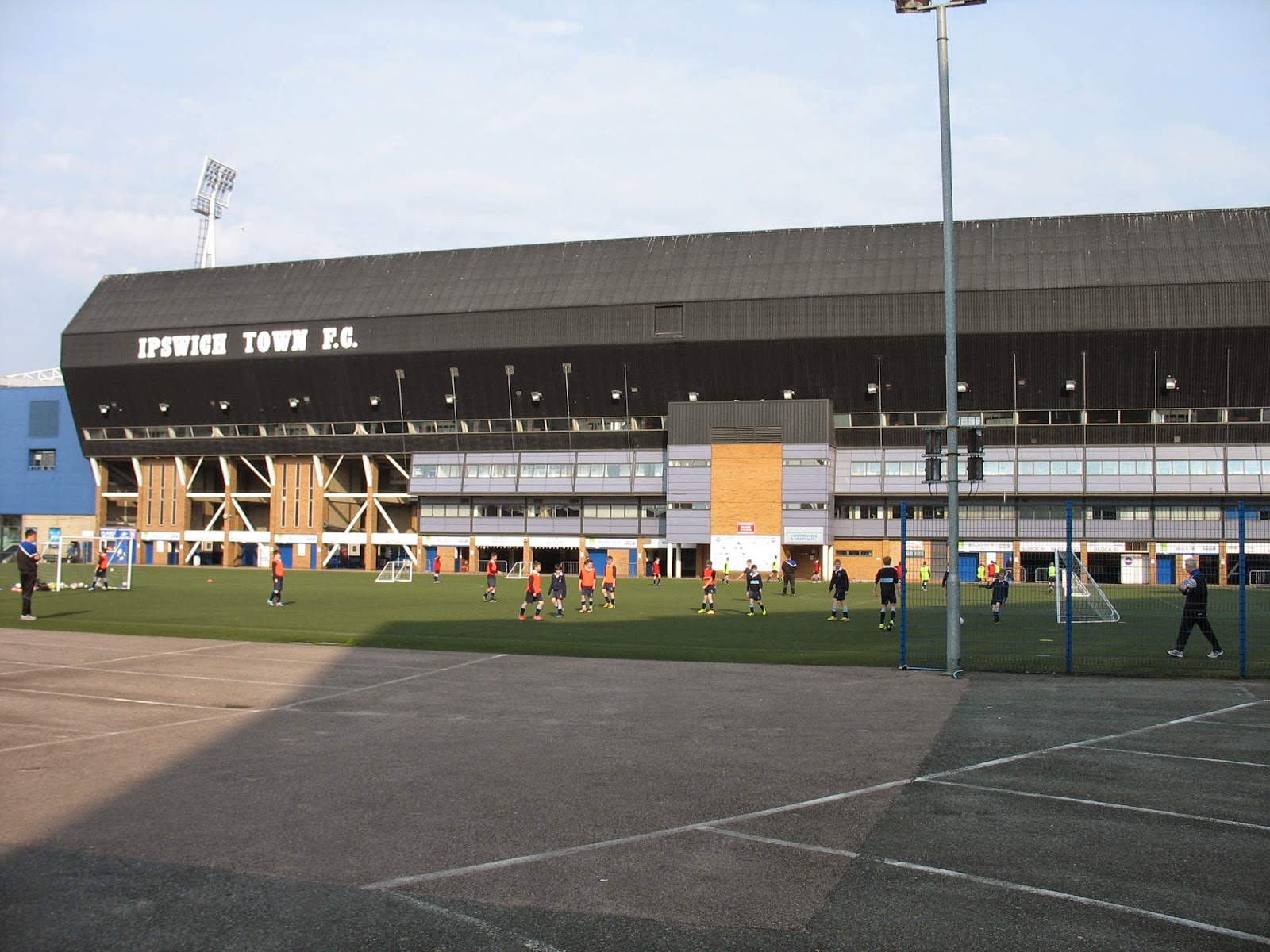
Portman Road consists of four stands and an administration block.
The old West Stand, now the East of England Co-operative Stand, was originally built in 1952 and fully up-dated in 1990.
It has two shallow lower tiers of seats and a larger upper tier separated by a row of executive boxes which stops some way short of the Bobby Robson Stand at the North end of the ground. It is somewhat unusual in that, instead of the club name or initials being picked out by different coloured seats, there is a message from the sponsors. The next stand to be built was the Cobbold Stand, which stretches along Portman Road itself, and consists of two tiers again with executive boxes built into the mid-line, though these have obviously been added later as they extend out from the stand with curious sloping roofs which provide a useful space to add extra advertising. Some of the seats at the top of this stand are restricted view as the steel work used to support the stand erupts in amongst the top four rows of seats.
Within the stand facing the road is the Hall of Fame and, directly across the road is the statue of Sir Bobby Robson. Also on the outer wall of the Cobbold Stand, named after the brewing family who were associated with the club for many years and who have provided five chairmen of the club, is one of the sites of commemorative plaques to fans who have passed on. There are other commemorative plaques to fans on the outer wall of the Bobby Robson Stand together with the plaque marking, in 2009, the naming of the stand by Lady Robson.

The two stands at either end of the ground are the newest, being built just after the turn of the century and are two tiered all-seater stands with rows of executive boxes along between the tiers. The players tunnel emerges from between the West Stand and the Alf Ramsey Stand and the police control box stands above it.
This fact led to the police control staff sending a steward over to me prior to the start of the match to warn me about taking photographs inside the stadium. I was taking my usual selections of still and video pictures before the game and I can only think they were unused to having their photo taken, being more used to photographing the innocent fans. The dug outs are in the traditional spot level with the half way line.

The statue of Sir Alfred Ramsey is outside the ground on the corner of Portman Road and Sir Alf Ramsey Way (formerly Portman Way).
Also outside the ground behind the Co-op Stand, but still within the confines of the stadium, is an astro turf practice pitch used by local sports clubs and youngsters being coached by Town staff. The spectators in the Co-op Stand pass through turnstiles on Sir Alf Ramsey Way and then walk over part of this pitch to access their entrance to the stand. The actual club practice ground and academy is situated towards the Kesgrave part of town.


Forest came to Portman Road on a dismal run of form, having drawn two and lost four of their last six games. This has caused us to slip out of the playoff places to seventh position just above Ipswich, on goal difference only,who conversely, are on a great run of form , winning their last two games against playoff rivals. They have taken 12 points from the last 18 available. After our showing against Charlton on Tuesday night, I certainly wasn't feeling too confident of success, but, strangely, I felt that Gary Brazil might pull some rabbits from the hat. He is in charge of the academy and as such knows the form of our younger players. The second string first teamers have not exactly been pulling up trees in recent games so perhaps Mr Brazil will ring the changes.

The first game between the two sides this season finished 0-0 at the CG with Forest frustrated after a dominant performance left us sharing the points. Once again,today,  Ipswich were captained by our ex-player Luke Chambers and once again he ran the gauntlet as he acknowledged the visiting fans presence. Some gave him the bird and some applauded. Former player Paul Anderson also started for Ipswich, but David McGoldrick, who has been in good form this term, appears to be injured and out for the season.

For us Gary Brazil did indeed ring the changes. Not only a change in formation, but a change in tactics which caught Mick McCarthy by surprise and put The Blues on the back foot for the whole of the first half. Young Ben Osborn, who had appeared on the subs bench quite a few times this season, was handed his first start, attacking on the left side of midfield. Lee Peltier also made his first appearance for the Reds after his strange loan move earlier in the week. This enabled Jara to move back to right back, Greg Halford moving into the middle of defence in place of the suspended (for ten yellows) Jamaal Lascelles. Personally, I think Lascelles has done a wonderful job coming in this season after the injuries to, first Kelvin Wilson, then to Danny Collins. Lascelles and Hobbs formed a fine partnership, but when Collins was fit to come back, Hobbs was injured so Lascelles kept his place. In fact, owing to injuries throughout this time, he has more than once been senior partner in central defence. But in the last few games I think the pressure has begun to tell and his form has dipped, so an enforced rest is just what the doctor ordered. Other changes see Raddi Majewski and Jamie Paterson come into the side. The most interesting additions to the squad were on the substitutes bench where young Jack Blake and Stephen McLaughlin made their first appearance for the senior team. (I think). It was also great to see former Forest goalie Steve Sutton stepping out onto the pitch to assist as goalkeeping coach to the senior squad in addition to his duties with the academy.

As I said, Forest were dominant in the first half and should have had more than the single goal scored by Collins from a corner in the fifth minute. Fox put the ball on a sixpence and there was no stopping Collins header. After this we attacked throughout the first half. Ipswich were caught cold and forced into a tactical substitution on 35 minutes with Anderson making way. Then Ipswich made another substitution at half time in an effort to wrest the initiative. Which they did, having far more of the play in the second half, though Forest continued to attack, though rather more sporadically. Finally the Ipswich pressure told, our defence went to sleep when a corner was taken short and the ball was headed into the net for the equaliser. No more goals were scored and the teams shared yet another draw.

I felt much better and more cheerful after this match, the team having played with great verve and enthusiasm with the fans keeping up a good noise throughout the game. Still just outside the playoffs, but facing the future with more optimism, especially as our own Psycho, aka Stuart Pearce, tough tackling legend, seems to have indicated that he is in fact still interested in managing us. What will the next week bring?

Tuesday, 1 April 2014

No Billy and Mugged by Charlton

I got back Sunday evening from my ground visits after the disgrace at Derby and all seemed normal. But it wasn't really. Though we didn't know it, Billy was yesterday's man, sacked by Fawaz. It only became apparent on Monday when the training staff didn't turn up at the Academy. This was a bit disturbing because we had a game on Tuesday evening with no one at the helm.

I was one of those who welcomed Billy back to the CG. True, he had a strange manner and anyone who had made his acquaintance warned us off him, but his record in the Championship is pretty good and I felt sure that he had learned a bit of common sense. At first he and Fawaz seemed to get on like a house on fire. But the "unfinished business", which I thought was to get Forest to the Prem, in fact seemed to consist of getting even with all his detractors and ruining the structure at the club purely for his own gratification. Many valuable members of the staff were sacked and the only person remaining seemed to be Jim Price, his friend, agent and solicitor who was awaiting a decision on his future after rumours of malpractice at his legal firm in Scotland.

I slowly began to change my opinion and, all in all, I am not sorry the little man has gone, the last months of his tenure were bizarre to say the least. Refusing to talk to sections of the media finally descended into a refusal to talk to anyone except East Midlands Today. There followed a strange interview which would have been funny except that it was conducted by our manager in all seriousness and not on some comedy sketch show. Then there was the dust up with the photographer at the Den (or Hillsborough; anyway, somewhere!) and the constant moaning about our injury crisis. I agree that key injuries were destabilising for a while because the players were going down like nine-pins, but Billy just kept on and on about it whilst making no attempt to change things, such as getting in loan players.

So we were Billy-less. What to do? Fawaz obviously had Neil Warnock lined up because no sooner was the ink dry on Billy's P45 than Warnock was chatting to Fawaz and had arranged for Lee Peltier to join us from Leeds on loan. So much for loans being impossible to do or taking a long time to arrange.

Then the farce began. Warnock decided that Fawaz is too hands-on (apparently it all blew up because Neil was expounding his thoughts on team selection and Fawaz had an alternative suggestion) and stopped talking and withdrew. Poor Lee Peltier, who by this time had signed, wanted to unsign, but it was too late. He only decided to come here because Warnock had persuaded him to do so. Then it became a sort of managerial musical chairs. One by one the list of possibles began to shrink, Psycho (Stuart Pearce, a legend at the club), Malky McKay, Gianfranco Zola  and some Spanish bloke all got a mention before excusing themselves for various reasons.

In the end Gary Brazil from the Academy became interim manager. With an odd assortment of trainers to assist. With only a few hours to assume command he picked a team that might have been a Billy team, full of the usual faces. The portents were not good. Charlton are near the bottom of the league, though they had won three games in succession before losing their last game to Burnley. However they had not won away since November, whilst Forest had not won at all since early February. Abdoun, Halford and Henderson came in and Paterson, Majewski and Moussi were left out. I arrived at the ground and felt totally discombobulated. The whole thing felt leaderless and unreal, the crowd was sparse and the pre-game ritual on the field was quite different; for one thing there were hardly any training staff in evidence.

The managers change, but the game followed the usual pattern. Forest had the best of the first half, hitting the post twice and having one goal-bound effort cleared off the line. 0-0 at half time. Second half Charlton regrouped, sensed that they could get something from the game and came more into it.  With ten minutes to go came the sucker punch. Lascelles, who had earlier been booked for the tenth time this season leading to a two match ban, pushed a gentle ball forward. The pass was too soft and a Charlton man nipped round the intended recipient, flew towards our goal and fired in a shot. The ball struck the post and oh, so cruelly, spun straight to a Charlton player unmarked just a few yards away from an open goal. Despite my prayers, he scored with ease. In the remaining time we had a couple more chances, but they went wide.

So the run continues even without the wee Scot. The next game is on Saturday away at Ipswich. It is practically a home game for me, twenty minutes through the countryside, car parking near Christchurch Park, a gentle walk down to the ground to see....what? A team showing new manager bounce, Gary Brazil picking a few of the younger players he knows so well or the same old collapse? Tell you one thing I can be sure of, it's never dull at Nottingham Forest!

Sunday, 30 March 2014

Savaged by the Sheep

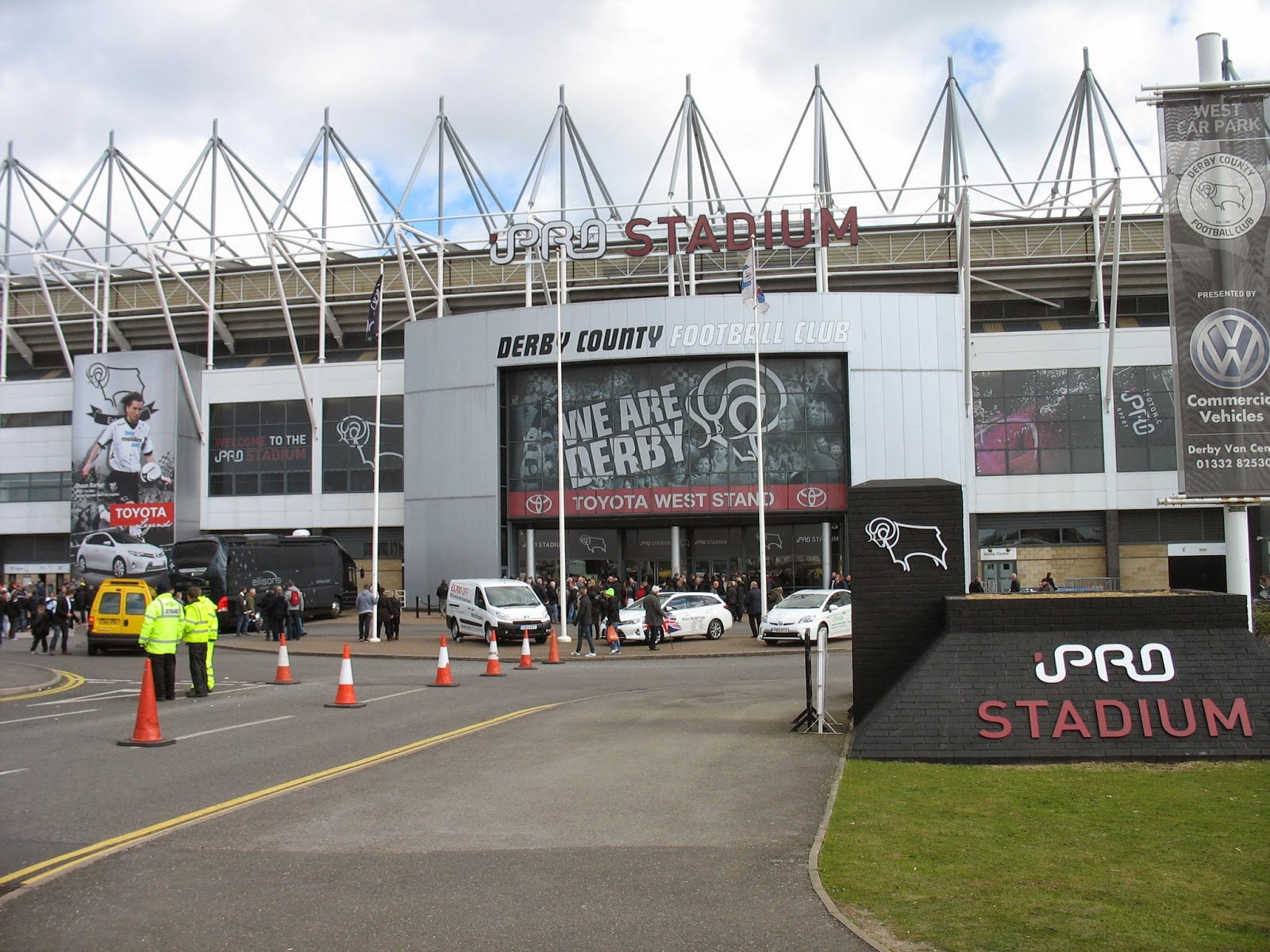
Well, here we are at last, the second of the fixtures every Forest fan looks for when the fixture list comes out in June. And, at the ripe old age of 71, my first time in Derby. So, of course, my first visit to Pride Park or the iPro as it's now called. There is no doubt it is the iPro Stadium as virtually every flat surface has the name stuck on it.

Also my first drive along Brian Clough Way as the road (the A52) linking the two cities is now called. The club moved from their old ground , the Baseball Ground which had been their home since 1895, to Pride Park in 1997. The Baseball Ground had in fact been used for baseball for a short period before football took over. The club nickname is the Rams, which stems from an association with the local Militia many years ago, who had a ram as their regimental mascot. The club was a founder member of the Football League in 1888, only four years after it's formation in 1884.

First impressions of Pride Park; very similar to the Riverside and the Stadium of Light, a plain 'bowl'. One large main stand and the rest just wrapping around the pitch. The only slight variation with those two is the executive boxes squeezed in the corner between the Main Stand (Toyota West Stand) and the North Stand. As with so many other grounds the stands bear impossibly long sponsorship titles which just exhaust my typing skills. The ground does give the impression of being very business-like and well run, with everything sponsored from the West Stand car park (VW) to the time added on at the end of each half. The Main Stand has two tiers with further executive boxes along the mid-line, a media centre at the top of the stand behind the top row of seats, the players tunnel and dugouts.
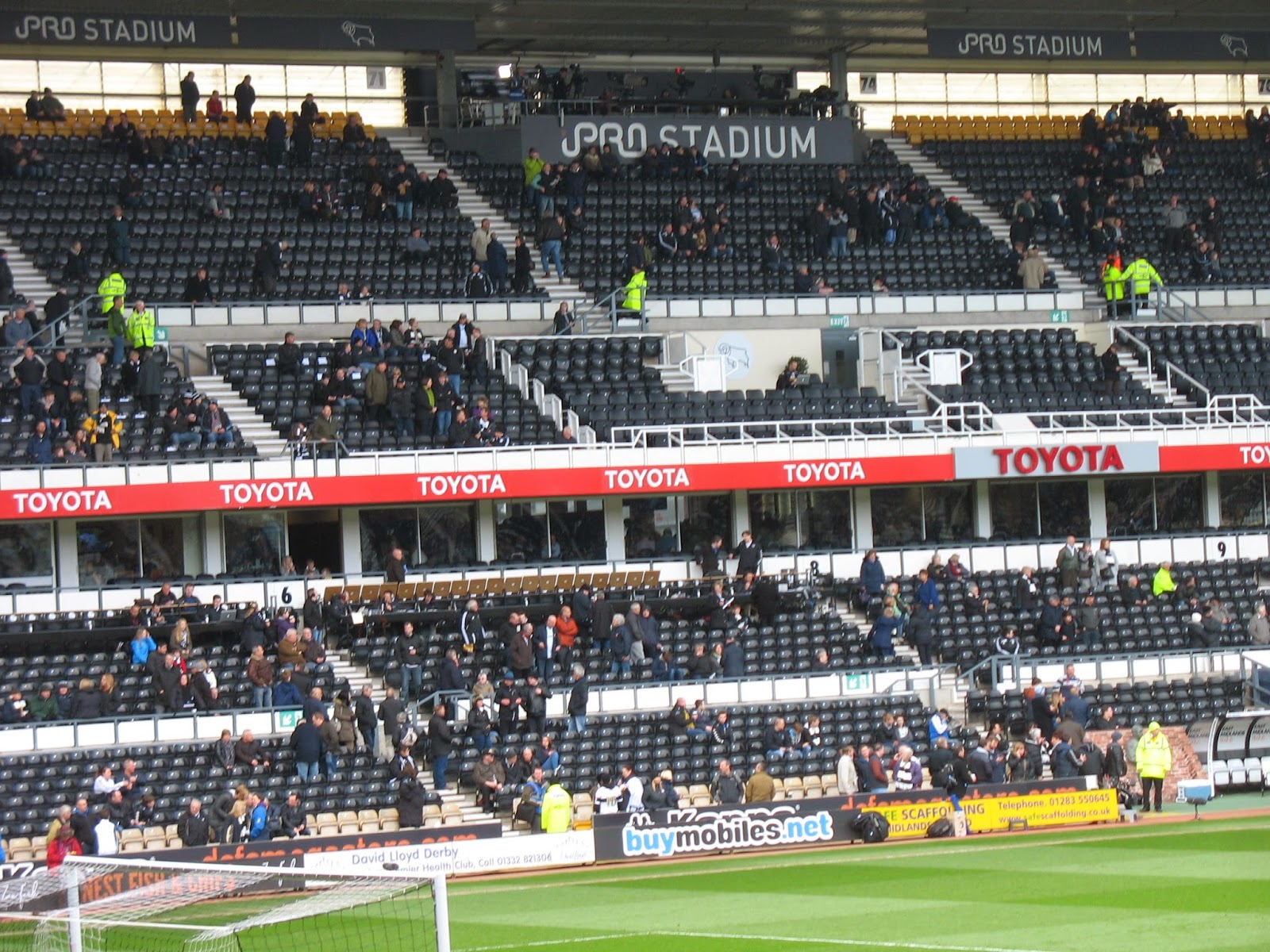
Alongside the home dugout is a bust of Steve Bloomer, at least that's what I'm told. I wasn't allowed to walk round to photograph it and my efforts to do so at long range were mostly thwarted by a steward in a bright high vis jacket who stood in front of it the whole game. Seems odd to have a bust of a hero where practically nobody can see it.

For me the main interest on my walk around the ground was the statue of BC and Peter Taylor, who were together the whole time that BC was manager at Derby.


 Peter Taylor nominally being his assistant but in reality his equal, one organising the playing side and the other the transfers in and out. In fact one of the reasons Brian cites for their bust up with the Derby board is one of the directors questioning Peter Taylor's role at the club. Anyway they left eventually and after a time moved to the City Ground, to complete a remarkable career together. For the pair were both volatile characters and had always had violent disagreements, which would finally cripple their partnership in 1982 when Taylor, after breaking their partnership because he was tired and unwell, returned to football as manager of Derby County!! The crowning insult was the signing of John Robertson by Taylor without telling Brian Clough, which led to BC resolving never to talk to him again.

At the back of the East Stand is the police control box, which has on odd sort of garden shed appearance when viewed from the outside.

The ground is situated in a retail park/industrial estate which does mean there are plenty of places to eat and park around the ground. Plus hotels,  mine was within easy walking distance making parking easy and giving me a good jumping off spot for my ground visits the next day.

A modern functional ground with little to distinguish it from others of it's ilk. And, with the club colours being black and white, nothing colourful about it. However, my reservations about the ground have not stopped Derby and their manager, a chap who left a few clubs and the National team under a cloud, from being right at the pointy end of this season's Championship. At the time of the game they were in third position, remote from the top two but securely in the playoffs, despite not scoring for, apparently, 365 minutes going back to 22 February. Forest are also on a pretty poor run, winless in seven games and playing poorly into the bargain.

The game itself started fairly evenly, but after just six minutes went downhill for the Reds. 3-0 at half time and 5-0 at the end. Just about everything went right for them and nothing for us, though, in truth, we didn't deserve anything. Billy Davies disappeared sharpish down the tunnel at the end and, though we didn't know it then, out of our lives. For he was sacked by Fawaz on the Sunday, though nothing appeared until the Monday morning when it was first noted that Billy's staff had not arrived at the training ground.

This was all in the future. I went back to the hotel trying to pretend that I was just an ordinary tourist totally bemused by the antics of the grinning and happy home fans. I slept well and went out into the bright Sunday morning sunshine with renewed vigour. It didn't last, the sunshine I mean. By the time I had made the short journey down to Burton Albion's ground, the Pirelli Stadium, it was raining. And the weather was to stay like that all day, classic sunshine and showers, which meant timing my visits to coincide with the brighter periods if possible.

I found the Pirelli Stadium quite easily because I was alerted as I passed a gigantic building impressed with the name "Pirelli National Distribution Centre".
 I have had trouble finding the way in to the car park at a lot of grounds and here was no different. I drove down the main road, not seeing an entrance to the ground, to a roundabout and, as the stadium is nestled neatly in the junction of the roads, I went right round the roundabout and drove slowly up the road until I saw a sign welcoming me to the Pirelli Stadium.  In I went and round to the front of the stadium, which reminded me of Morecambe's ground, the Globe Arena. Which is not really surprising because I have since read that the Pirelli was a model for that stadium.

It is my habit to check doors as I walk around the grounds I visit and, blow me, I found the front door (to the main reception) open. In I go. No one about. I wander upstairs and find a gentleman diligently vacuuming a carpet in a function room on the first floor. I ask him if it is possible to see around the ground. He told me he had no authority, but directed me to the players tunnel when there was a member of the ground staff working, so I walked down to make my request to a very startled kit man. He explained that not that long ago there had been an unauthorised entry by some ruffians which had necessitated a call to the police and it had rather shaken him up. So he is now keen on security. However, he soon recovered his composure and very kindly allowed me to take my photos and wander round, a very nice man.

The Pirelli Stadium is relatively new, being first used in 2005. It is built on the former site of the tyre company's sports club which was donated to the club in exchange for naming rights. At the time the Brewers, an obvious nickname for a club situated in a town world renowned for brewing, were in the Football Combination, but achieved league status in 2009. Strangely, they were not the first club from Burton to play in the Football League. In the late nineteenth century two teams from Burton played in Football League division 2; indeed for three seasons (1894-1897) Burton Swifts and Burton Wanderers played in that league at the same time. Shortly thereafter they amalgamated as Burton United and stayed in the league only until 1907. They folded soon after leaving yet another club, Burton All Saints, as the town team. But they went out of business as well in 1940 and it wasn't until Burton Albion were formed in 1950 that the town had another team.


The stadium is simple in design. There is a large all-seated main stand housing the club offices, changing rooms etc which dominates the ground. The other three stands are almost identically designed shallow  terraces (although, of course, the one opposite the main stand is longer than the others) which each have a small cafe/snack bar or function room situated at the back of the stand. The East Terrace (Coors Stand) just advertises a snack bar menu, but the other stands invite you to "The Vera Goode Suite" and "The Tom Eccleshall Suite". It is worth mentioning that the groundsman regularly receives awards and praise for the quality of the pitch. There is one score board/video screen, fixed to the fascia of the Coors Stand, which effectively prevents the away fans from seeing whatever is on there.

It was a cold, damp day and the wind was getting up, so I decided to make tracks to my next ground, the Britannia Stadium, home of Stoke City.

The journey to the Britannia was an easy one even for this "route challenged" person. As it was I was merrily bowling along when I suddenly realised the stadium was there on my left. A hasty, but smooth turn off and past a myriad of car sales showrooms to the large main car park. Stoke City FC were formed as Stoke Ramblers in 1863 making them the second oldest league club and just two years older than Forest. They became Stoke City in 1925 after the town of Stoke-on-Trent was elevated to city status. The club moved to their present ground in 1997 after playing at the Victoria Ground since 1878. They were founder members of the Football League in 1888, though they dropped out in 1890 after failing to gain re-election, their place going to Sunderland, but in the following year, 1891-2, the league was expanded to two leagues and Stoke were re-admitted. The nickname of the club is the Potters, a nod to the dominant industry of the area.

On the day I visited Stoke were playing away so the ground was locked up and deserted. I wandered around. The ground was built on the site of Stafford No2 Colliery, which closed in 1969, and is on a plateau high above the city so is very windy if the weather is the least bit inclement, but it also, because of the elevated position, appears in splendid isolation.
The Main Stand is on it's own as is the stand next to it, the South or Marston Pedigree Stand. The other corner of the ground is two stands (The Boothen End and the Novus Stand) joined at the corner forming a continuous whole. In between the South Stand and the Novus Stand is a large video screen which effectively prevents anyone standing on the earth bank behind it from seeing into the stadium. I took up position on this bank trying to take photos into the ground and found the screen perfectly positioned to prevent a decent view of the playing surface.

Stanley Matthews was a great hero of my youth (I once sent him a birthday card whilst he was at Blackpool and received a nice handwritten reply) and his presence at Stoke is noted in several ways. He was born in one of the six towns of Stoke (Hanley) and supported Port Vale as a lad, but eventually signed for Stoke City where he spent, in total, nineteen years, playing over 300 games for them. On the front of the Main Stand are two large posters of players, one of whom is Stan. I thought this to be a bit poorly printed, but when I got close-up I noted his picture is superimposed over many hundreds of pictures of Stoke fans, a sort of mosaic. This gives the printing on the poster, "Proud to be a Potter", a double meaning.
Also, in a small garden area behind the Boothen End is a statue to Stanley Matthews consisting of three statues (a sort of sculptural triptych) demonstrating his amazing body swerve. The address of the club is Stanley Matthews Way and, finally, his ashes were buried under the centre spot.


Behind the Boothen End is Delilah's Bar, a reference to one of the songs that the Potters fans sing. The players tunnel comes out at the Marston Pedigree Stand end of the Main Stand though the dug outs are in the middle of the stand. A fine ground in which the Stoke fans create a great atmosphere, which would be even louder if the proposed closing of the gap between the Novus and South Stand ever takes place. There is a "Wall of Fame" in one corner of the Main Stand for remembering Potters fans who have passed on.

It was cold and windy and more rain was approaching. I was unlikely to see more (I had already nearly fallen off a wall trying to photograph the Main Stand) so I set off to find Port Vale FC at their ground, Vale Park, Burslem, Stoke-on-Trent, noting that they are one of the few clubs whose name gives no idea of their geographical location. Just a short hop and a skip up the road.

This again proved quite easy to find and I dived into the first gateway I found, which proved not to be the correct one, but which, nevertheless, gave me a parking spot right next to Tommy Cheadle's Pub,
a reference to an ex Vale player who came into football late (another whose career was broken or delayed by WWII). A hard defender he suffered so many head injuries it is reported his team mates nicknamed him "wooden head".

The real entrance to the ground was up some stairs by the pub and a winding road round to the back of the main stand where there are offices, changing rooms and, as I was to find out, the physio's room. The ground appeared to be shut up tight, so I took a few photos of the stand and the statue representing the Sproson family, particularly Roy Sproson who played well over 800 games for the Valiants. Other members of the family also played many times for Port Vale.

The club origins, both formation and naming, are lost in the mists of time, but are recorded as being in the 1870s. They have played at Vale Park since 1950.

I hung about outside the ground working out my tactics, as the ground is pressed in by housing on one side, a small industrial area on the other and Hamil Road running along the front, none of the areas giving very atmospheric photographic opportunities. However, just at that moment, a very nice car drew up in front of the Lorne Street Stand. Thinking an executive of the club had arrived to audit the books or whatever, I approached the surprisingly young man who emerged. It turned out he was an injured player come for a bit of physiotherapy prior to their next match on Tuesday (actually, I didn't bring them much luck because they lost that match to Bristol City 5-0 and the manager was so irritated he had a bit of a heated exchange with a section of the travelling support) and I was invited in whilst permission was sought for me to see inside the ground.

The groundsman duly arrived and allowed me a brief tour of the ground. There are four stands of varying ages. The newest, the Lorne Street Stand, is still not completed having only had half the seats installed,

with a large lower tier, a row of executive boxes and a much smaller upper tier. The Betbright Stand opposite is much smaller with two tiers of seats.
This stand is joined to the GMB Union Stand by a sort of cricket pavilion type stand which apparently is the oldest part of the ground. The GMB Union Stand is similar in appearance to the Betbright Stand and is also connected to the Main Stand so achieving a coherent whole.

At the other end of the pitch is the single tiered Signal1 Stand which houses the away supporters and the scoreboard which dangles from the roof, at such a height that it looks as if it might impact on the sight-line of the spectators in the top row of seats.

Thus, as at the Pirelli, the away supporters are denied a sight of the scoreboard. Between this stand and the Betbright Stand is the police control box. The floodlight poles have, on some of them, the mobile phone antennae so familiar around the country these days.

After a long and very wet season, the pitch looked in excellent condition and I note that the groundsman has been commended on numerous occasions on the quality of his pitch. I thanked him, said goodbye to the players in the treatment room (wishing them success in their upcoming match against Notts County) and left to go to Crewe. I got into the car just in time as another cloudburst descended on the area.

It's strange, but true that many football league clubs (and, for the purposes of my trips, all clubs whether belonging to the FL or Premier League are football league clubs) are grouped in small pockets around the country. The Staffordshire group are no exception, so I only had a short drive to my next club, Crewe Alexandra FC, one of those clubs with a unique suffix to their name, though the origins of the name are uncertain, opinion being divided between the Princess Alexandra or the Princess pub! They were formed in 1877 and first played at the Alexandra Recreation Ground before leaving there on a peripatetic journey around Crewe to finally settle at the current Gresty Road site (still officially the Alexandra Stadium) in 1906, which is pretty much in the same location as the original Alexandra ground. The ground is hard by one of the most important railway sites and junctions in the country so it's no surprise that one of the nicknames of the club is the Railwaymen, though I spoke to a couple of supporters and a steward and they all referred to their club as The Alex.

I arrived in the vicinity of the ground, passed over the railway bridge which was my main ID point and had noted Gresty Road was first turn left. I was surprised to find that the road was like a byroad, very narrow and rather insignificant, but discovered that it is only like this at the top end, it broadens out on it's junction with South Street. I turned into the car park entrance to be met by a steward who refused me entry because this was the start/finish point of a cycle race. So I drove down Gresty Road and parked in a side street, no hardship. Actually I was glad that there was an event taking place because that usually means that there are club officials about somewhere. And so it turned out. After a couple of false starts, I met a charming young man who escorted me into the ground after checking that I really did only want a few minutes of his time. We got into the ground and undercover only just in time. The rain started sheeting down again, so much so that I thought it might actually affect some of my photographs, but as happened throughout the day, the rain was soon over and I could venture out.

The Main Stand (the Air Products Stand) built in 1999 dominates the ground and after looking at the various satellite images available it is easy to see why the club had to develop in this way, because the ground is hemmed in on all the other sides, growing out into the large car park was the only way to go. The other stands in the ground were also built in the 1990s to make the ground all-seater.
Opposite the main stand is the quaintly named Ice Cream Van Stand ( originally the Popular Side) with CAFC picked out in black on the red seats. At first glance the two ends of the ground look identical, but the Railway End (I couldn't see a sponsor name on it anywhere) has executive boxes running along the back whilst the Absolute Recruitment Stand (the Gresty Road End) has slightly more seats and no executive boxes.

The Pop side has a media box on the mid line of the roof and, at the Gresty Road end, a police control box partly built into the stand. The floodlight pylons here are just, as at Vale Park,  floodlight poles with those adjacent to the Main Stand having additional lights halfway up the pole.

I left Gresty Road to their cycle race, the retail stalls and booming music to make my way home. Well, not quite. Earlier in the season I had not quite completed my visits to West Bromwich Albion or Walsall so, as I was on the M6 and they are just a stone's throw off that road, I thought I would try them again. A total waste of time!! The Banks's Stadium, better known to most as the  Bescot Stadium, home of Walsall, was still submerged in the usual Sunday market which I had hoped would be packing up at this time of the day. No chance, the stalls were still hard up to the stadium walls, the stall holders doing a roaring trade and, as far as I could ascertain, the stadium itself shut up tight.

So I moved on to the Hawthorns, home of West Brom, after extricating myself from the retail traffic around Walsall. I had, on my last visit, been promised access to the stadium if there was no match the previous day. I had checked, there was no match the previous day to cause me a problem, so I felt in buoyant mood. This was soon dashed.  A dapper individual, rather a smart aleck (anyone who opens the conversation calling me 'young man' when he's at least twenty years younger than me deserves no respect) was just checking in a stadium tour and flatly denied me access for even five minutes. Actually he wanted me to pay £10 and join his tour, which lasted two hours. Not wishing to spend that time in his company, I told him it was his ground and he could do what he liked with it. I left, a bit miffed. Actually, a lot miffed

So I drove home. I had met so many people really enthusiastic about their ground and club and ready to spare five minutes of their time to help me, that it was disappointing at the last stop to meet such a person. Still it takes all sorts.